Introduction
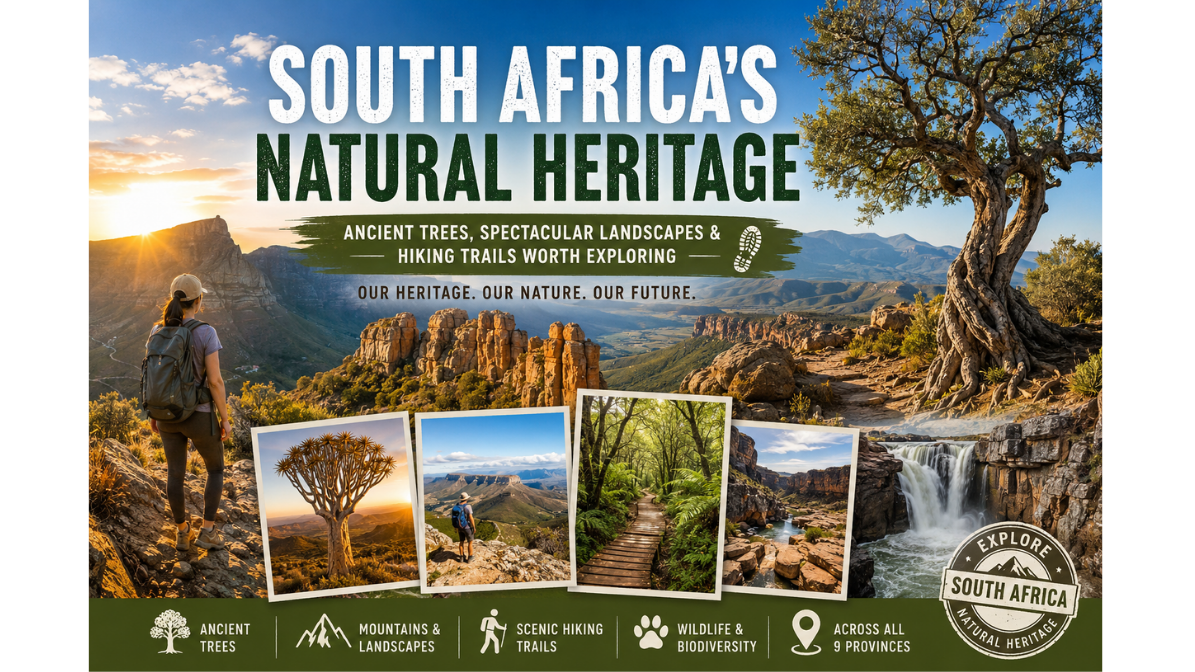
When South Africans celebrate Heritage Day, we often think about culture, traditions, food, and historic landmarks. But heritage is much more than old buildings and museums. Some of our country’s most precious heritage treasures are found in nature.
From ancient Wild Olive trees that have stood for centuries to towering mountains, indigenous forests, dramatic coastlines, and unique ecosystems found nowhere else on Earth, South Africa’s natural heritage is something truly special.
One of the best ways to experience this heritage is on foot. Hiking allows us to slow down, appreciate our surroundings, and connect with landscapes that have shaped the history and identity of our country.
Whether you’re an experienced hiker or simply enjoy a family walk, these natural heritage destinations deserve a place on your South African bucket list.
The Ancient Wild Olive Trees: Living Witnesses to History
The Ancient Wild Olive Trees


Wild Olive trees (Olea europaea subsp. africana) are among South Africa’s oldest living treasures. Some specimens are believed to be several hundred years old and have witnessed generations of history unfold around them.
These hardy trees can survive droughts, strong winds, and harsh conditions. Their twisted trunks and silvery leaves make them instantly recognizable, and they provide food and shelter for many bird species.
When hiking through parts of the Western Cape, Eastern Cape, and KwaZulu-Natal, you’ll often encounter these living pieces of history.
Many indigenous communities regarded large Wild Olive trees as important gathering places and symbols of endurance.
Many people are surprised to learn that some Wild Olive trees in South Africa are believed to be several hundred years old.
The indigenous Wild Olive (Olea europaea subsp. africana) grows throughout many parts of South Africa and has long been valued by local communities. These trees are incredibly resilient and can survive droughts, strong winds, and harsh conditions that would destroy many other species.
Their gnarled trunks and twisted branches tell stories that stretch back generations.
For centuries, Wild Olive trees have provided:
- Shade for travellers
- Shelter for birds and wildlife
- Wood for tools and traditional crafts
- Food sources for indigenous animals
Walking among these ancient trees reminds us that nature often preserves history better than any monument ever could.
In the Western Cape, you can explore ancient wild olive trees (Olea europaea subsp. africana) and early 20th-century cultivated groves. The Cape’s indigenous wild olives have grown in gorges and hills for centuries, while the region’s historic olive estates feature some of the oldest commercial groves in the country.
Prime Locations to View Ancient & Historic Olive Trees:
- Paarl Valley: Paarl is home to some of the country’s oldest cultivated olive groves.
- De Hoop Farm: This estate features century-old olive groves planted at the turn of the 20th century.
- Cascade Country Manor: Situated at the foothills of the Drakenstein Mountains, the estate features hundreds of old olive trees dating back generations.
- Salem Biblical Garden: This picturesque sanctuary boasts natural wild olive trees alongside century-old planted groves.
- Indigenous Wild Olives: The Olea africana is a naturally occurring, deeply resilient species that you can find scattered across indigenous fynbos margins, Table Mountain gorges, and the Overberg region.
Hiking Opportunities
Wild Olive trees can be found along numerous hiking routes in:
- The Western Cape
- Eastern Cape
- KwaZulu-Natal
- Limpopo
Many mountain and forest trails feature magnificent specimens that have likely stood for hundreds of years.
When hiking, look closely at their trunks. Some are so twisted and weathered that they resemble natural sculptures.
The Cederberg: A Wilderness Rich in Heritage


The Cederberg is one of South Africa’s most spectacular wilderness areas.
Located a few hours from Cape Town, this rugged mountain region combines natural beauty, fascinating geology, and cultural history.
The area is famous for:
- Ancient San rock art
- Dramatic sandstone formations
- Rare plant species
- Incredible night skies
- Remote hiking routes
The Cederberg is also home to the endangered Clanwilliam Cedar tree, a species found nowhere else in the world.
Hiking Highlights
Wolfberg Arch
One of the most famous hikes in the region.
The route takes hikers through rocky terrain before reaching an enormous natural sandstone arch carved by centuries of wind and rain.
The views alone make the climb worthwhile.
Maltese Cross
This distinctive rock formation resembles a giant stone cross.
The trail is moderately challenging and offers excellent opportunities for photography.
Algeria Forest Trails
Perfect for families and casual hikers looking to experience the beauty of the Cederberg without tackling strenuous mountain routes.
Why It Matters
The Cederberg preserves both natural and cultural heritage. Ancient San rock art sites provide evidence of people living in this landscape thousands of years ago.
Table Mountain: More Than Just a Landmark
Many visitors see Table Mountain as simply a tourist attraction.
In reality, it is one of the world’s most important biodiversity hotspots.
The mountain forms part of the Cape Floral Kingdom, the smallest floral kingdom on Earth and one of the richest in plant diversity.
Thousands of plant species occur here, many found nowhere else.


Popular hiking routes include:
- Platteklip Gorge
- Skeleton Gorge
- India Venster
The Drakensberg Mountains


7
The magnificent uKhahlamba-Drakensberg Park combines spectacular scenery with cultural significance.
Highlights include:
- Towering cliffs
- Rare wildlife
- Ancient San rock art
- World-class hiking trails
It is recognized internationally for both its natural beauty and cultural importance.
The Baobab Trees of Limpopo


6
Some baobab trees are estimated to be over a thousand years old. These giants store water in their trunks and have become symbols of resilience and longevity.
For centuries they have served as landmarks, meeting places, and part of local folklore.
Why Natural Heritage Matters
Natural heritage sites:
- Protect biodiversity
- Preserve important ecosystems
- Support tourism and local communities
- Provide educational opportunities
- Allow future generations to experience South Africa’s natural wonders
Whether you’re standing beneath an ancient olive tree, hiking through the Cederberg, or admiring a giant Yellowwood, you’re experiencing a living part of South Africa’s heritage.
Hiking Trails
Platteklip Gorge
The most direct route to the summit.
Although challenging, it rewards hikers with breathtaking views over Cape Town.
Skeleton Gorge
Starting in Kirstenbosch Botanical Garden, this route passes through indigenous forest before reaching the top.
It offers a completely different experience from the more exposed routes.
India Venster
A more adventurous route featuring scrambling sections and spectacular scenery.
Heritage Value
Table Mountain is not only beautiful; it represents one of the most unique ecosystems on the planet.
Protecting it means preserving species that exist nowhere else.
The Garden Route Forests and Giant Yellowwoods
The Giant Yellowwood Trees


South Africa’s national tree, the Real Yellowwood, can live for hundreds of years.
Some of the country’s largest specimens can be found in the forests of Garden Route National Park and the Tsitsikamma National Park.
Standing beneath one of these giants gives visitors a sense of how small we are compared to nature’s timescale.
Few experiences compare to standing beneath a giant Yellowwood tree.
These magnificent trees are among the largest indigenous trees in South Africa.
The Real Yellowwood is South Africa’s national tree and some specimens are hundreds of years old.
Long before roads and towns existed, these forests covered vast areas of the southern Cape.
Hiking Trails
Woodcutters Journey
Located near Knysna, this trail explores ancient indigenous forest once used by woodcutters.
Visitors gain insight into both natural and human history.
Garden of Eden Walk
Ideal for families.
The boardwalk takes visitors through lush indigenous forest filled with towering trees and birdlife.
Diepwalle Forest Trails
A wonderful opportunity to experience old-growth forest and appreciate the importance of conservation.
Heritage Importance
These forests remind us of what much of the southern Cape once looked like before large-scale development.
Tsitsikamma: Where Forest Meets Ocean
The name Tsitsikamma is often translated as “place of abundant water.”
This region combines indigenous forest, dramatic coastline, rivers, waterfalls, and marine ecosystems.
It is one of South Africa’s most scenic destinations.
Hiking Trails
Mouth Trail
An easy walk leading to the famous suspension bridge.
Perfect for families.
Waterfall Trail
One of the most popular hikes in the area.
The route follows the rugged coastline to a beautiful waterfall.
Otter Trail
Often considered South Africa’s most famous hiking trail.
The five-day adventure showcases the best of the Tsitsikamma coastline.
Heritage Importance
Tsitsikamma protects both marine and terrestrial ecosystems, making it a unique natural treasure.
The Drakensberg: South Africa’s Mountain Kingdom
The Drakensberg is one of Africa’s most impressive mountain ranges.
Its soaring cliffs, waterfalls, valleys, and grasslands create landscapes unlike anywhere else in South Africa.
The region is recognised internationally for both natural beauty and cultural significance.
Hiking Trails
Tugela Falls Hike
Leads hikers to one of the tallest waterfalls in the world.
The views from the escarpment are unforgettable.
Amphitheatre Hike
A bucket-list experience for many South African hikers.
Giants Castle Trail
Offers excellent opportunities for birdwatching and wildlife sightings.
Heritage Importance
The region contains thousands of San rock art paintings, making it one of the most important archaeological areas in Africa.
The Baobabs of Limpopo
Some Baobab trees are believed to be more than a thousand years old.
These giants have witnessed centuries of human history.
Their unusual appearance has inspired countless stories and legends.
Hiking Opportunities
Many private nature reserves and conservation areas in Limpopo offer walking trails where visitors can encounter these ancient trees.
Walking beside a Baobab often leaves visitors feeling humbled by its immense age and size.
Heritage Importance
Baobabs are living monuments that connect us with generations who came before us.
Free State
Golden Gate Highlands National Park
Golden Gate Highlands National Park
This is probably the most famous hiking destination in the Free State.
Why it’s special:
- Spectacular sandstone cliffs that glow golden at sunrise and sunset.
- Home to rare wildlife and indigenous grasslands.
- Part of the scenic Maluti Mountains region.
Popular hikes:
- Brandwag Buttress Trail (short but iconic)
- Mushroom Rock Trail
- Wodehouse Peak Trail
- Ribbok Trail
Map note: “Golden sandstone cliffs and mountain hiking.”
Clarens and the Maluti Foothills
Clarens
Often called the “Jewel of the Free State.”
Popular hikes:
- Titanic Rock Trail
- Kloof Mountain Trails
- Various private conservancy routes
Map note: “Art village surrounded by hiking trails and mountain scenery.”
Northern Cape
Augrabies Falls National Park
Augrabies Falls National Park
One of South Africa’s most dramatic natural wonders.
Why it’s special:
- The mighty Orange River plunges into a deep granite gorge.
- Extraordinary desert scenery.
- Unique geology and hardy desert vegetation.
Popular hikes:
- Dassie Trail
- Klipspringer Hiking Trail (multi-day)
- Gorge viewpoints walk
Map note: “Powerful waterfall and desert hiking.”
Richtersveld Transfrontier Park
Richtersveld Transfrontier Park
One of South Africa’s most unique landscapes and a UNESCO World Heritage Site.
Why it’s special:
- Incredible succulent diversity.
- Rugged mountains and desert scenery.
- Home to the Nama people’s cultural heritage.
Popular hikes:
- Helskloof Trail
- Various wilderness hiking routes
Map note: “UNESCO World Heritage desert mountain wilderness.”
Mokala National Park
Mokala National Park
A lesser-known gem near Kimberley.
Why it’s special:
- Conservation success story.
- Open plains, koppies, and wildlife.
- Excellent birdwatching.
Popular hikes:
- Several self-guided walking routes.
Map note: “Wildlife, grasslands, and scenic walking trails.”
Karoo Hiking Trails and Natural Heritage Sites
Karoo National Park (Western Cape)
Karoo National Park
Located just outside Beaufort West, this park showcases the classic Great Karoo landscape.
Why it’s special:
- Fossils dating back millions of years.
- Unique succulent and semi-desert ecosystems.
- Spectacular mountain scenery.
- Important conservation area for endangered species.
Hiking Trails:
- Fossil Trail
- Bossie Trail
- Rest Camp Walking Trails
Map note: “Ancient fossil landscapes and Karoo wildlife.”
Camdeboo National Park & Valley of Desolation (Eastern Cape Karoo)
Camdeboo National Park
One of the most dramatic landscapes in South Africa.
Why it’s special:
- Towering dolerite columns created over millions of years.
- Panoramic views across the Karoo.
- Rich geological history.
Hiking Trails:
- Crag Lizard Trail
- Valley of Desolation Walking Trail
Map note: “Ancient rock formations overlooking the Karoo.”
🌵 Meiringspoort Hiking Trail
Meiringspoort
A beautiful gorge connecting the Little Karoo and the Great Karoo.
Why it’s special:
- Massive sandstone cliffs.
- Crystal-clear streams.
- Indigenous vegetation hidden within the gorge.
Hiking Highlight:
- Meiringspoort Waterfall Trail (short and family-friendly)
Map note: “Spectacular mountain pass and waterfall.”
Swartberg Nature Reserve
Swartberg Nature Reserve
Part of the famous Swartberg Mountains and a UNESCO World Heritage area within the Cape Floral Region.
Popular Hikes:
- Arangieskop Trail (challenging overnight hike)
- Various mountain routes around Prince Albert and Oudtshoorn
Why it’s special:
- Incredible mountain scenery.
- Rare fynbos species.
- Historic Swartberg Pass.
Map note: “UNESCO-listed mountains and rugged hiking.”
Nieu-Bethesda and the Compassberg
Nieu-Bethesda
A charming Karoo village surrounded by spectacular mountain scenery.
Hiking Trail:
- Compassberg Summit Hike
At around 2,500 metres, Compassberg is the highest peak in the Eastern Cape outside the Drakensberg region.
Why it’s special:
- Sweeping Karoo views.
- Rich birdlife.
- Historic village atmosphere.
Map note: “Highest peak in the Eastern Cape Karoo.”
Tankwa Karoo National Park
Tankwa Karoo National Park
One of South Africa’s most remote and untouched wilderness areas.
Why it’s special:
- Extraordinary stargazing.
- Rare succulents.
- Vast open landscapes.
Hiking Opportunities:
- Short wilderness walks.
- Self-guided exploration routes.
Map note: “Remote desert wilderness and star-filled skies.”
Ancient Trees of the Karoo
Since you’re interested in old trees, consider adding a section about:
The Shepherd’s Tree (Witgatboom)
Shepherd’s Tree
Found throughout arid regions of the Karoo and Kalahari, some specimens are believed to be hundreds of years old. These remarkable trees survive in extremely harsh conditions and have long been used by people and wildlife alike.
Ancient Wild Olive Trees
Many old farms and mountain valleys in the Karoo still have Wild Olive trees that may be several centuries old.
“The Karoo: South Africa’s Ancient Open-Air Museum”
You could describe the Karoo as a place where every mountain, fossil bed, dry river, and ancient tree tells part of a story stretching back millions of years. Unlike many heritage sites, the Karoo’s history isn’t locked inside a building—it’s written across the landscape itself.
Why Hiking Helps Us Appreciate Heritage
In today’s fast-paced world, many people experience nature through a car window or smartphone screen.
Hiking encourages us to slow down and truly engage with the environment.
Benefits include:
Physical Health
- Improved fitness
- Better cardiovascular health
- Increased strength
Mental Well-being
- Reduced stress
- Improved mood
- Better focus
Environmental Awareness
- Greater appreciation for conservation
- Understanding local ecosystems
- Respect for natural heritage
Family Connection
Many of South Africa’s trails are suitable for families, making hiking a wonderful way to create lasting memories.
Preserving Our Natural Heritage for Future Generations
South Africa’s natural heritage faces numerous challenges.
These include:
- Climate change
- Habitat destruction
- Pollution
- Invasive species
- Uncontrolled development
Every visitor can help by:
- Staying on marked trails
- Not disturbing wildlife
- Taking litter home
- Supporting conservation initiatives
- Respecting protected areas
Small actions make a big difference.
Conclusion
South Africa’s heritage is not confined to museums and monuments. It lives in ancient Wild Olive trees, towering Yellowwoods, rugged mountain ranges, pristine coastlines, and centuries-old Baobabs.
By exploring these places on foot, we gain a deeper appreciation for the landscapes that have shaped our country’s story. Every trail tells a tale, every ancient tree has witnessed history, and every protected area plays a role in preserving our shared heritage.
So lace up your hiking boots, pack a water bottle, and head outdoors. Some of South Africa’s greatest heritage treasures are waiting to be discovered beneath open skies and along winding trails.
CLICK ON THE LINK FOR A DETAILED MAP:
South Africa’s Living Heritage: Forests, Mountains and Trails Worth Discovering
https://www.google.com/maps/d/embed?mid=1ADlzRUmwUSf6J8I0hQXkxQqSuj716eU&ehbc=2E312F